
A $10 million or $20 million real estate fund can feel substantial when you’re the sponsor responsible for raising it. Depending on the strategy, that may be more than enough capital to acquire several properties and execute the business plan.
The calculation can change when RIAs, broker-dealers, and licensed securities professionals become part of the capital-raising strategy. What feels like a large offering to the sponsor may still be too small for a broker-dealer to justify the additional due diligence, compliance, supervision, and expense required by the professionals being asked to help distribute it.
Raising From Your Own Investor Network Is Different
Most real estate sponsors begin by raising capital directly from their own investors. They build relationships, educate prospective investors, host webinars, develop referral sources, and gradually create a network of people who understand their investment strategy.
That model can work very well for a smaller fund. If a sponsor has enough investor relationships to realistically raise and deploy $10 million, there may be no reason to launch a $100 million offering simply because the larger number sounds more impressive.
In fact, sometimes we recommend the opposite. A smaller initial capitalization target can allow the sponsor to acquire the first assets, establish the fund’s track record, and potentially expand the offering later if the fund documents allow it.
That analysis starts to change when the strategy becomes, “I want financial professionals helping raise this money too.” At that point, the size of the offering has to support more than just the acquisition strategy.
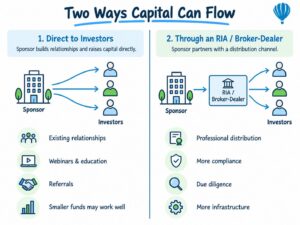
RIAs and Broker-Dealers Aren’t Simply Referral Sources
Sponsors often look at a large RIA or broker-dealer network and focus on the amount of investor capital represented by the organization. A firm with hundreds of financial professionals and billions of dollars in client assets can understandably look like an attractive solution to the fundraising problem.
Getting an offering approved for those investors, however, takes work. The sponsor, management team, track record, investment strategy, fees, conflicts, financial assumptions, and offering documents may all receive scrutiny before the fund is ever presented to a client.
Broker-dealers also have their own supervisory and compliance responsibilities when selling private securities offerings. RIAs operate under a different regulatory framework, but they still need to become comfortable recommending a private investment to their clients.
The practical issue for the sponsor is straightforward. Someone has to spend the time and resources necessary to understand the fund, and that work needs to be justified by the potential opportunity. This is also an area where third-party reports are important for compliance purposes.
Why Fund Size Starts to Matter
Consider two funds with similar real estate strategies and experienced sponsors. One is raising $5 million and the other is raising $50 million.
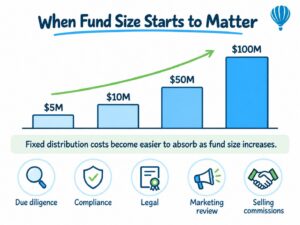
Both offerings may require significant review. Prior performance may need to be substantiated, principals may need to be diligenced, and the fund economics, risks, conflicts, and investment assumptions may all receive attention.
The potential distribution opportunity is still dramatically different. A firm spending significant resources approving a $5 million fund may ultimately only place a relatively small amount of investor capital into the offering, while the same review applied to a $50 million fund could support a much larger amount of distribution.
That doesn’t mean every RIA or broker-dealer has a $50 million minimum. It helps explain why, in our experience, larger funds often receive more interest when sponsors are looking for large-scale third-party distribution.
The issue isn’t that a smaller fund lacks investment merit. The issue is whether the opportunity is large enough to justify the compliance infrastructure and resources required by everyone involved.
Smaller Funds Can Still Work With Broker-Dealers
Smaller funds are not automatically excluded from broker-dealer distribution. There are managing broker-dealers that specifically work with smaller private securities offerings and operate differently from a major wealth-management platform deciding whether to distribute a fund across a large national network.
One strategy may involve fund managers directly engaging licensed securities representatives associated with private placement friendly broker-dealers helping sell the offering. Instead of trying to place a smaller fund on a major national platform, the issuer is building a securities sales team around the offering itself.
That can work, but it adds expense. Managing broker-dealer fees, selling commissions, legal costs, due diligence, marketing review, and compliance expenses all need to fit within the economics of the fund.
Those costs become more noticeable as the offering gets smaller. A fixed amount of compliance and due diligence expense represents a much larger percentage of a $10 million raise than a $100 million raise.
Third-Party Due Diligence Can Add Another Layer
Another consideration is independent third-party due diligence. Companies such as FactRight or Mick Law PC review private offerings and prepare reports that RIAs, broker-dealers, and other wealth-management firms can use as part of their own evaluation process.
Depending on the engagement, that review may look at the sponsor and principals, prior performance, fees, conflicts, projections, underlying properties, valuations, and other risks associated with the offering. For the sponsor, the report can provide another resource for financial professionals evaluating whether they are comfortable with the investment.
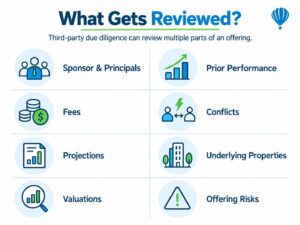
It also adds another expense. Third-party diligence does not replace the RIA’s or broker-dealer’s own responsibilities, but it can become part of the infrastructure required for broader distribution.
Once again, fund size matters because those expenses have to fit somewhere. The larger the offering, the easier it may be to justify fixed costs associated with getting the fund prepared for professional distribution.
Sometimes the Right Answer Is Still a Smaller Fund
This may sound inconsistent with the idea of starting with a smaller fund, but it really isn’t. The correct fund size depends heavily on where the sponsor expects the capital to come from.
Suppose a sponsor already has an investor network capable of supporting a $10 million fund and enough deal flow to acquire several properties. Launching a realistic $10 million offering may make far more sense than creating a $100 million fund with no credible plan for raising the additional capital.
The sponsor can complete the first capitalization, acquire assets, establish additional history, and potentially expand the fund target later. That can make future fundraising easier because the fund has actual properties and operating history to discuss.
Now change the objective. If the sponsor wants to build a distribution network involving RIAs, broker-dealers, registered representatives, and third-party due diligence, the smaller offering may no longer provide enough economic room to support all of that infrastructure.
The larger fund may make sense not because the sponsor suddenly needs $100 million to buy real estate. It may make sense because the capital-raising strategy itself requires enough scale to justify the additional distribution costs and compliance work.
Bigger Isn’t Automatically Better
There is also a danger in assuming that professional distribution means the offering should simply be made as large as possible. Increasing the maximum offering amount in the PPM does not create the experience, investor demand, personnel, or acquisition pipeline necessary to actually raise and deploy that capital.
A sponsor who has historically raised $3 million or $5 million at a time may not be ready to launch a $100 million fund simply because larger offerings may attract more attention from distribution partners. There still needs to be a realistic story explaining why the sponsor can deploy that much capital and why investors should trust the team to manage it.
Fund size should therefore be a strategic decision rather than a vanity number. The better question is how much capital the sponsor can realistically raise and responsibly deploy through the distribution channels they intend to use.
Sometimes that analysis leads to a smaller initial fund. In other situations, particularly when professional distribution is central to the strategy, it may support a much larger offering from the beginning.
Decide Where the Capital Is Coming From Before You Launch
Sponsors naturally spend a great deal of time defining the investment side of a fund. They determine the asset class, target markets, leverage, acquisition criteria, return objectives, and what makes a property fit the fund’s buy box.
The capitalization strategy deserves the same level of attention. Sponsors should know whether they expect to raise primarily from their existing investor network, through direct marketing, through registered securities professionals, through RIAs and broker-dealers, or through some combination of those channels.
Those decisions can affect the fund size, expenses, investor economics, compensation structure, due diligence requirements, and the way the entire offering is organized. A fund designed around an existing group of investors may look very different from one intended for widespread wealth-management distribution.
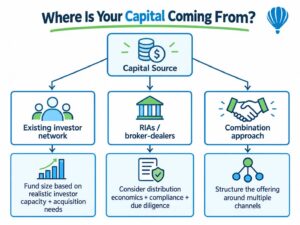
There is no one-size-fits-all answer to how large a private real estate fund should be. A $10 million fund may be exactly right for one sponsor, while another may need a $50 million or $100 million offering before professional distribution becomes economically realistic.
The mistake is deciding on fund size first and figuring out where the investors will come from later. The investment strategy and the capitalization strategy should be designed together so the structure actually supports what the sponsor is trying to accomplish.
Crowdfunding Lawyers helps sponsors structure private funds around both the securities requirements and the practical realities of raising capital. If you’re considering launching a fund or expanding into RIA or broker-dealer distribution, schedule a free consultation with our team to discuss the fund structure, securities exemption, distribution strategy, and offering terms that fit your plans.